

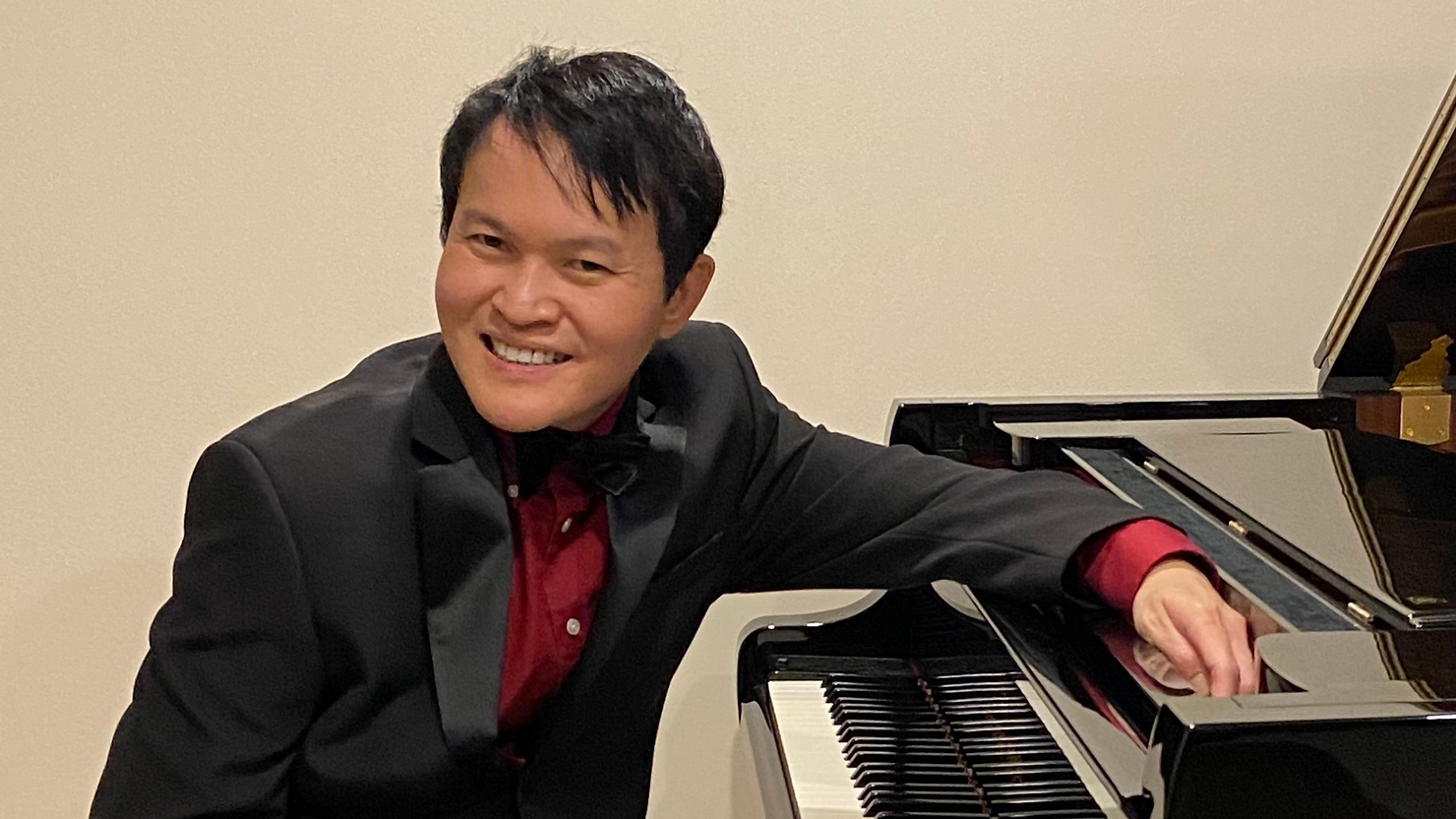
Keng playing The Pink Panther Theme arranged by Jacob Koller
What is special about WIPAC?
I first came to WIPAC to meet people like myself – pianists who have pursued other careers – and how they balance it with their careers.
I was recently told that WIPAC has the highest cash awards for any piano competition of its kind. There are also many composers and period awards, which is extraordinary. Oh, and all that growling in Liszt and Rachmaninoff makes hungry lions, so the food is always good and plentiful at the receptions.
The connections I made with people kept me coming back for a decade even when I was no longer eligible to compete. In the recent competitions I’ve been a volunteer.
How did you find the competition in terms of organizations and level of the contestants?
WIPAC events are very social. There are receptions after every round for participants to socialize. In terms of level, it is usually very mixed, ranging from those just getting back into playing after decades away to those who could be professional. It also varies from year to year.
What was your repertoire at WIPAC?
-Mozart Sonata in F K 332
-Liszt No. 2 from Three Concert Studies “La leggierezza”
-Griffes Barcarolle Op.6 No.1
-Chopin Ballade No.4 Op.52
-Debussy No.1 from Images Book 1 “Reflets dans l’eau”
-MacDowell No.2 from Two Fantasies Op.17 “Witches Dance”
-Moszkowski No.1 from Three Piano Pieces Op.34 “Valse”
What did you learn from WIPAC?
Be prepared to adapt your playing (and maybe even pieces) on very different pianos and venues. There’s often not a lot of time to try out the pianos, so know which passages in the music that you’re going to play to try out.
What would you recommend to pianists wanting to take part?
Choose a varied repertoire – not just of different musical styles, but also in the length of time you’ve played them and the difficulty level. Don’t choose all pieces that are new to you. Remember you have to perform them within a few days and getting them all ready at the same time when you’re trying to balance the rest of your life can be overwhelming.
There’s a lot to deal with – performing in a new venue on an unfamiliar instrument, performance nerves, maybe not having the opportunity to warm up, sweat on the keys from the heat, cellphones ringing in the middle of performances, or flatulence that leaves you paralyzed … choose something well within your ability to start.
I always find it refreshing to hear compositions new or unfamiliar to me. You’ve got to like the whole audience twiddling their fingers out of time to every note you play to choose Chopin’s fourth Ballade

I often hear competitors often blame not making to the next round on their execution on a particular day. I think the choice of pieces and the conception and playing style are often underestimated, factors often decided weeks and months before the competition.
Judging in these competitions is very subjective and the competitors and jury can also change from year to year, so don’t pre-empt the outcomes based on previous years’.
Don’t forget to enjoy the journey and make new friends!
What are your musical aspirations in the short and long term?
I would like to play more chamber music, both as a pianist and cellist. In solo piano music, I’d like to play works that are less often heard. I’m also studying jazz.
How do you manage work and piano?
I generally don’t try to. There was a lot of music to prepare when I took part in WIPAC, so the period leading up to the competition I mostly didn’t try to play through pieces but worked on very specific passages.
More about Keng
Winner of the 2012 Washington International Piano Artists Competition, Keng Siong Sim was born in Singapore and started playing the piano at 11.
He was awarded a scholarship to the University of York (UK) and studied piano with Kaoru Bingham and Ka-Kit Tam.
At the University of Massachusetts Amherst, where he obtained his Master of Music, Keng studied piano with Nadine Shank and Estela Olevsky and cello with Matt Haimovitz. In addition, he holds the ARCM (Associate of Royal College of Music, UK) and LTCL (Licentiate, Trinity College of Music, London) in piano performance.
A chamber music enthusiast, Keng has been awarded the Advanced Certificate in Cello Performance by the Associated Board of the Royal Schools of Music. He enjoys ensemble playing and is a current member of the Friday Morning Music Club and Capital City Symphony.
